Electricity Survival Guide: How to manage your energy and be 100% self-sufficient this holiday
August is synonymous with absolute freedom. It’s the perfect month to lose yourself in secluded coves, sleep by a cliff or venture deep into the mountains. However, to savour that independence without having to set foot on a campsite or search for a power point every 24 hours, there’s one system in your vehicle you need to know inside out: the electrical system.
Managing your energy supply often causes plenty of headaches and raises questions: How long will my battery last if I plug this in? Can I use my capsule coffee machine? Is my solar panel powerful enough? Today, we’re demystifying on-board electricity with this survival guide.
1. Auxiliary batteries: Your energy reserve
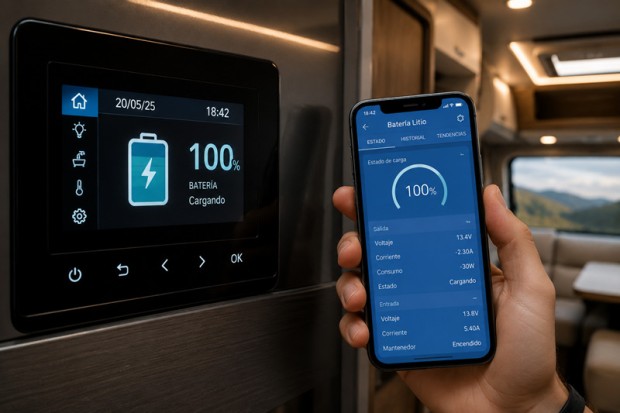
Unlike the engine battery (which is only used for starting the engine), the domestic battery powers the lights, the water pump, the heating and the fridge. Its technology has a direct impact on your range:
- AGM batteries: These are the most common types. They are reliable and economical, but they have a significant technical limitation: it is not recommended to discharge them beyond 50 per cent of their total capacity, as they degrade rapidly. If you have a 100Ah AGM battery, you actually only have 50Ah of usable capacity.
- Lithium (LiFePO4) batteries: They represent the ultimate evolution. Although their initial cost is higher, they can be discharged to as much as 90 per cent of their capacity without suffering any damage, they charge up to three times faster – provided suitable chargers are installed – and they weigh half as much. With a 100Ah lithium battery, you’ll have almost twice as much usable energy as with a traditional AGM battery.
2. Solar panels: Generating clean, free energy
In August, the sun becomes your best ally and your source of endless energy. Solar panels recharge your batteries throughout the day whilst you’re enjoying the beach or going on an excursion.
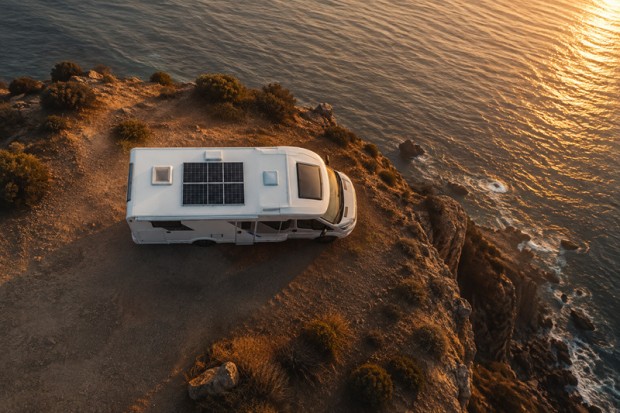
- Basic maintenance: For a windscreen to perform at 100 per cent, its surface must be clean. Dust picked up on the road, bird droppings or pine resin can reduce its efficiency by up to 40 per cent. Before setting off on a journey, give it a wipe with clean water and a soft cloth.
- The importance of the regulator: Make sure your system is fitted with an MPPT charge controller rather than a PWM one. MPPT controllers harness up to 30% more of the energy generated by the solar panel, managing peaks in production more effectively during the peak hours of August. If you have a lithium battery, the charge controller must also have a lithium charge curve.
3. The power inverter: Taking your home sockets on the road
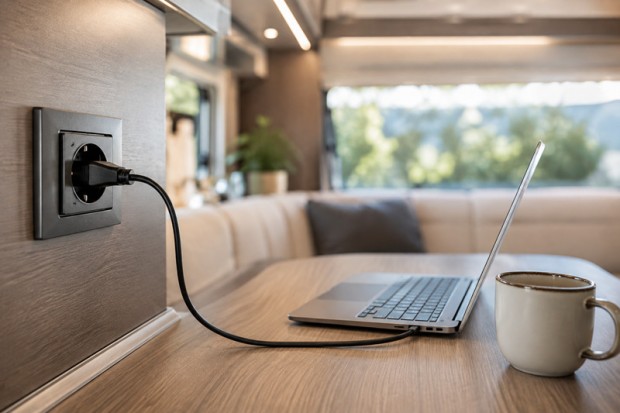
The standard sockets in your motorhome only work when you’re connected to a 230V power supply at a campsite. If you’re out in the countryside, your devices will run on the 12V from the battery. This is where the inverter comes in – a device that converts 12V direct current into 230V alternating current.
- Of a pure sine wave: If you’re going to install one, always make sure it’s a pure-wave inverter. Cheap modified-wave inverters can damage the sensitive electronic components in laptops, drones or coffee machines.
- Standby power consumption: Inverters use battery power simply by being switched on, even if nothing is plugged in. Remember to switch it off using the on/off switch or remote control as soon as you have finished using the appliance. In addition, you should allow for approximately 25 per cent additional power consumption by the inverter, on top of the power it is supplying.
4. A quick checklist to make the most of your electricity in August
- Switch to LED: If your motorhome is a few years old, replace all the interior light bulbs with LED bulbs. This will drastically reduce energy consumption (by up to 85 per cent).
- Smart charging: Charge your mobile phones, camera batteries or electric scooters during the day, when the solar panels are feeding energy into the grid at maximum capacity. Avoid doing so at night, when you are relying solely on the battery’s reserve power.
- Gas fridges: If your fridge is tri-fuel (it runs on 12V, 220V and gas), remember to switch it to gas mode as soon as you stop on the road. When running on 12V, it uses a huge amount of power, which would drain your battery in a matter of hours if the engine is switched off.
Managing your energy isn’t about depriving yourself of comforts, but about using them sensibly. With these tips, your independence this August is more than assured!